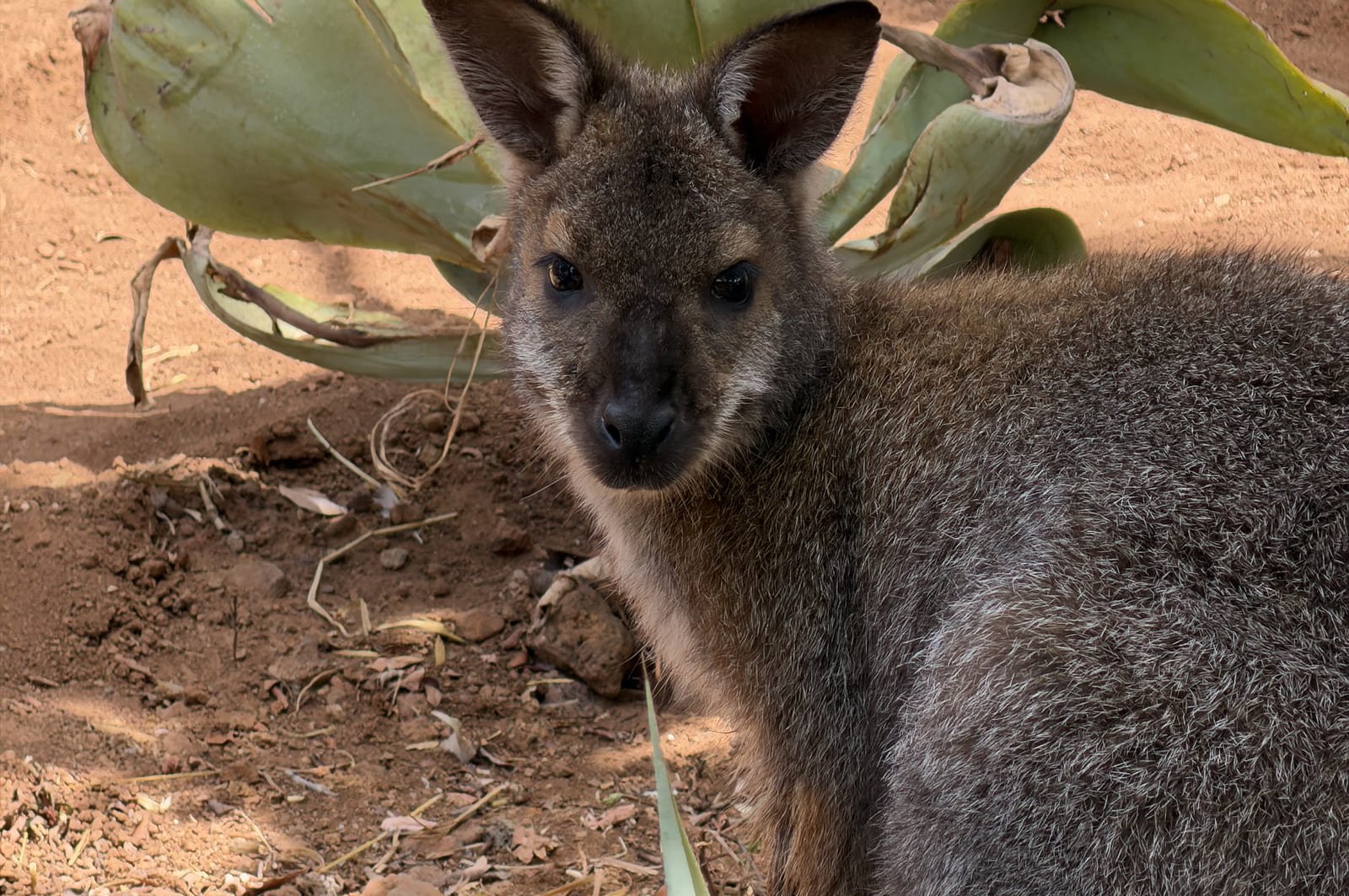
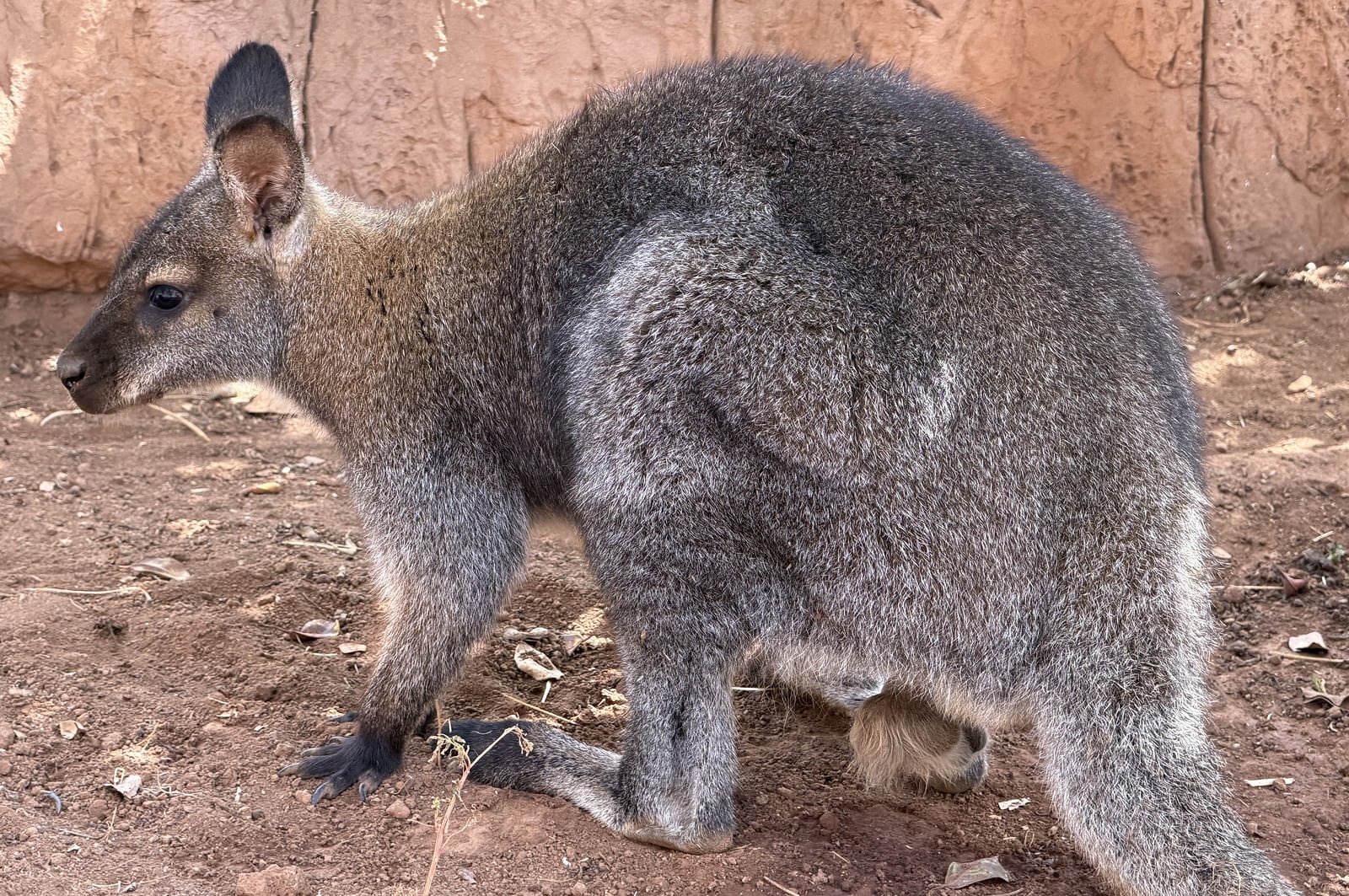
Bennett's wallaby is a subspecies of the red-necked wallaby and one of the best-known and most commonly kept marsupials in zoos around the world.
It stands out for its grayish fur with reddish tones on the neck and shoulders, its calm character and its great ability to adapt to different environments.
The species is relatively secure in the wild and faces no immediate risk of extinction.
Reproduction
Bennett's wallaby can reproduce year-round, although births are usually more frequent at certain times depending on environmental conditions.
After a gestation period of approximately 30 days, a single offspring is born, which completes its development in the marsupial pouch for about 9 months. Like other macropods, females exhibit embryonic diapause, which allows them to delay the development of a new embryo until the previous offspring leaves the pouch.
Behaviour
It is primarily a crepuscular and nocturnal species, although in quiet environments it may be active during the day. It lives alone or in small, loosely structured groups and spends much of its time grazing.
It moves by leaping powerfully, reaching speeds of over 40 km/h in short bursts and covering several meters in length. It is a curious animal, generally calm and not very aggressive.
Threats
In the wild, the main threats to Bennett's wallaby include habitat loss and fragmentation, roadkill, and predation by introduced species, especially foxes.
However, its populations are stable and the species is listed as Least Concern (LC) by the IUCN. Its wide distribution and adaptability contribute to its good conservation status.
Feeding
Bennett's wallaby is a herbivore that feeds mainly on grasses, herbs, leaves, shoots, and shrubs.
In zoos, their diet usually consists of high-quality hay, specific feed for macropods or herbivores, fresh grass, and a variety of vegetables and leaves, providing a balanced diet rich in fiber.
Distribution
VU (Vulnerable)
It is at high risk of extinction in the medium term.
NT (Near Threatened)
It is not yet at risk, but could be soon if conditions worsen.
ALL
Not Used
EX (Extinct)
There are no longer any living individuals of the species.
EW (Extinct in the wild)
Only specimens survive in captivity or in scientific collections.
EN (Endangered)
It has a very high risk of disappearing in the wild if conservation measures are not taken.
CR (Critically Endangered)
It faces an extremely high risk of extinction in the near future.