




Monkey Park opened its doors in 1991 in the south of Tenerife, near Los Cristianos. Since then we have been a centre dedicated to the care, rescue and reproduction of endangered species, with a special focus on primates. Thanks to the island's privileged climate, our animals live outdoors all year round, which favours their welfare and reproductive cycles. Our work focuses on conservation projects, creating new genetic lines to ensure the survival of species such as ring-tailed lemurs, Brazza monkeys, patas and white-headed marmosets. Although we give priority to these species, all our animals receive the utmost care and dedication on a daily basis.
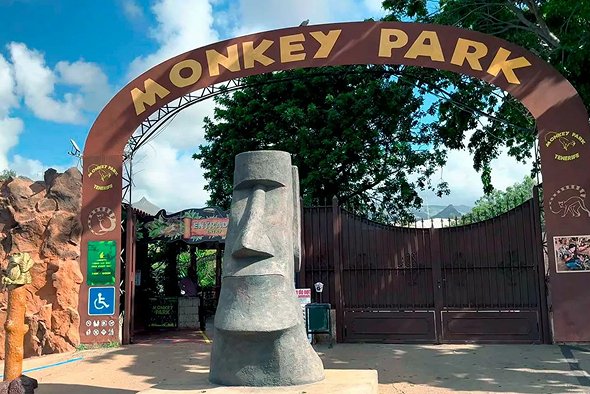
At Monkey Park, our extensive experience in caring for animals inspires us to respect them deeply and offer them the best possible conditions. No animals perform in shows; our focus is on showing their natural behaviour, encouraging an authentic bond with nature.
We are committed to the conservation of endangered species, participating in breeding and protection programmes, and we always respect their wild behaviour, avoiding humanising them.
Education is a pillar of our park: during the visit, visitors learn about the origin, diet and conservation status of each species. We oppose the purchase or sale of exotic animals; all those living in our facilities come from rescues, exchanges or conservation programmes, never for purely exhibition purposes.
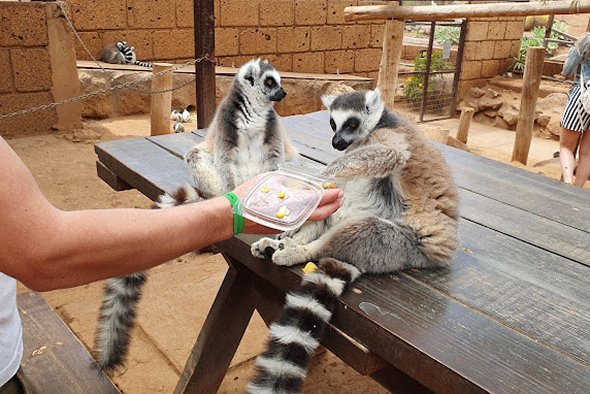
For us it is the fundamental pillar of animal welfare, a bigger or more beautiful habitat for the eyes of our visitors is not the best for our animals, we do everything thinking of them first. After many years of work we concluded that the perfect habitat for a species does not exist in a zoo, even so we strive every day to improve our facilities so that the life of our animals in our park is as good as possible.
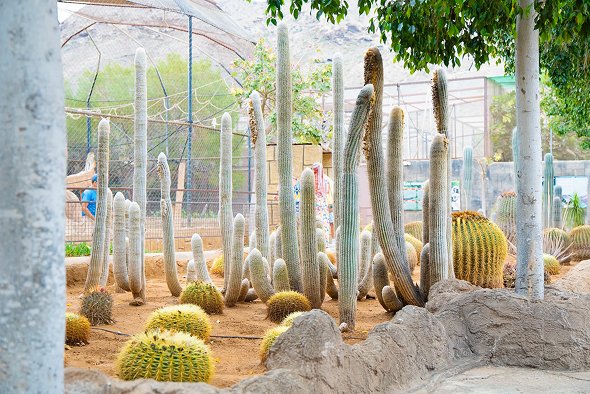
Monkey Park is a private and self-sustainable project, with no outside help. The donations we receive at the entrance go to 100% to rescue centres for dogs and cats on the island, always anonymously.
Our employees do not receive tips for interacting with visitors; we aim to keep the animals' activities natural and free of financial incentives.
Ticket prices are kept low and stable, ensuring the sustainability of the park and the welfare of the animals. We only charge for entrance fees, drinks, food and souvenirs; no additional money is requested inside the park.

At Monkey Park each animal receives individualised care from a trusted caregiver, forming a lasting bond that guarantees well-being and immediate veterinary attention in the event of any unforeseen event. Our state-of-the-art veterinary equipment and equipment, together with habitats designed to reduce stress and risk, allow the animals' health to be maintained in a safe and natural way.
We respect and value all our animals, including those with disabilities or special conditions. We believe that all deserve equal opportunity, adapted challenges and a dignified life, with none considered lesser because of their imperfections.

It is at high risk of extinction in the medium term.

It is not yet at risk, but could be soon if conditions worsen.

Not Used

There are no longer any living individuals of the species.

Only specimens survive in captivity or in scientific collections.

It has a very high risk of disappearing in the wild if conservation measures are not taken.

It faces an extremely high risk of extinction in the near future.

The species is relatively secure in the wild and faces no immediate risk of extinction.
