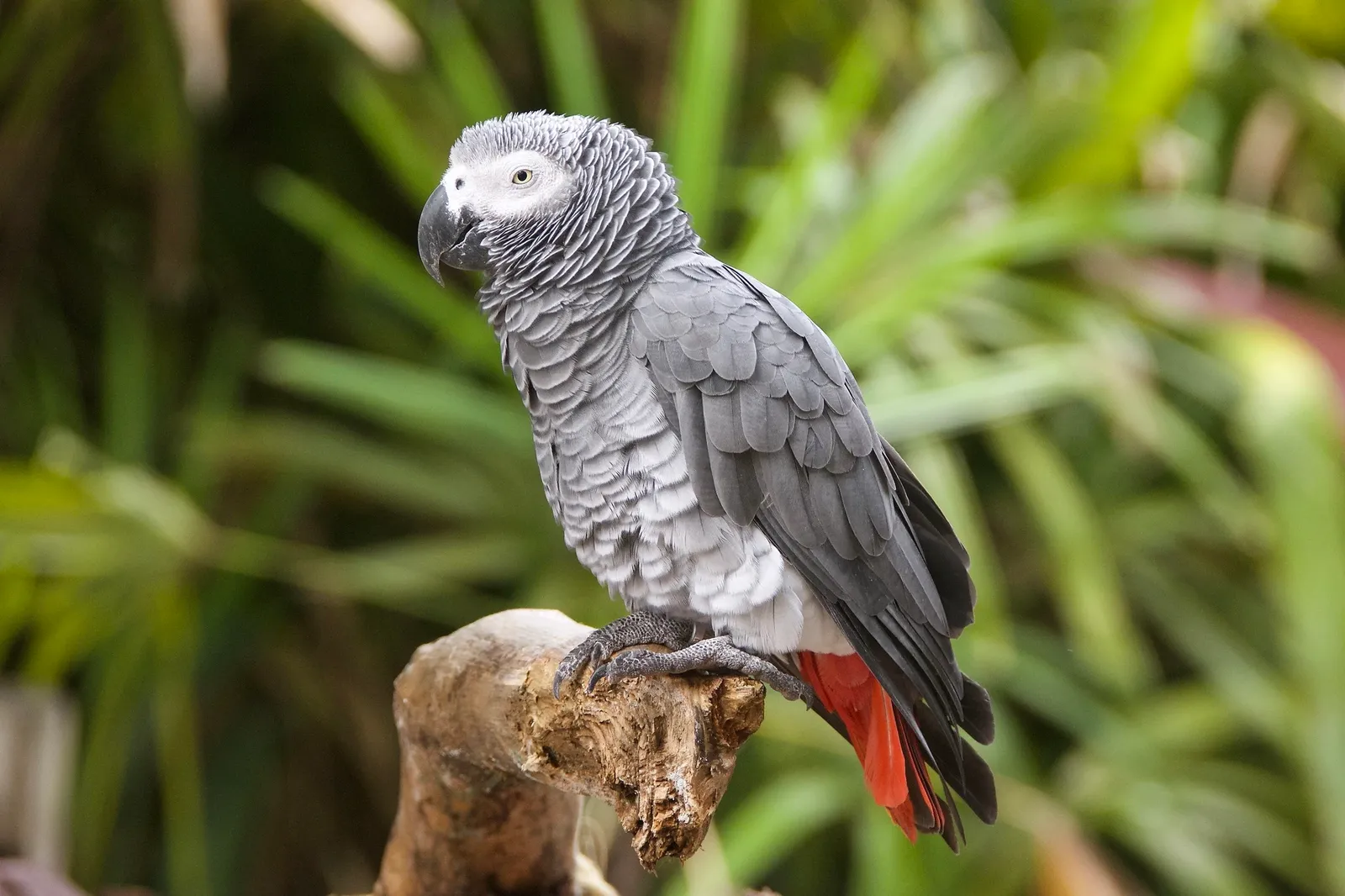
The African grey parrot has silvery-grey plumage, with a distinctive bright red tail and a strong black beak. It is known for its great intelligence and its extraordinary ability to imitate sounds and words, which makes it very recognisable among parrots.
It has a very high risk of disappearing in the wild if conservation measures are not taken.
Reproduction
The African Grey Parrot reaches sexual maturity at around 4-6 years of age. It breeds in stable pairs and uses cavities in tree trunks for nesting. The female lays 3 to 5 eggs, which she incubates for about 30 days, while the male feeds her. The chicks remain in the nest for 10-12 weeks before flying for the first time.
Behaviour
The African grey parrot is a highly social and intelligent species, which lives in flocks in the wild and establishes strong bonds with its conspecifics. It is noted for its great ability to imitate sounds and words, considered one of the most developed among birds. It also shows a very curious and active behaviour, needing constant stimulation to avoid boredom.
Threats
Icon for menu
Threats
Threats
The African Grey Parrot is threatened mainly by habitat loss and illegal capture for the pet trade, which has led to a sharp decline in its wild populations. These pressures have led to it being listed as Endangered by the IUCN.
Feeding
The African grey parrot feeds mainly on fruits, seeds, nuts and vegetables, although in the wild it also eats flowers, bark and sometimes small insects. In captivity it needs a varied and balanced diet, avoiding toxic foods such as avocado, chocolate and salt.
Distribution
VU (Vulnerable)
It is at high risk of extinction in the medium term.
NT (Near Threatened)
It is not yet at risk, but could be soon if conditions worsen.
ALL
Not Used
EX (Extinct)
There are no longer any living individuals of the species.
EW (Extinct in the wild)
Only specimens survive in captivity or in scientific collections.
CR (Critically Endangered)
It faces an extremely high risk of extinction in the near future.
LC (Least Concern)
The species is relatively secure in the wild and faces no immediate risk of extinction.