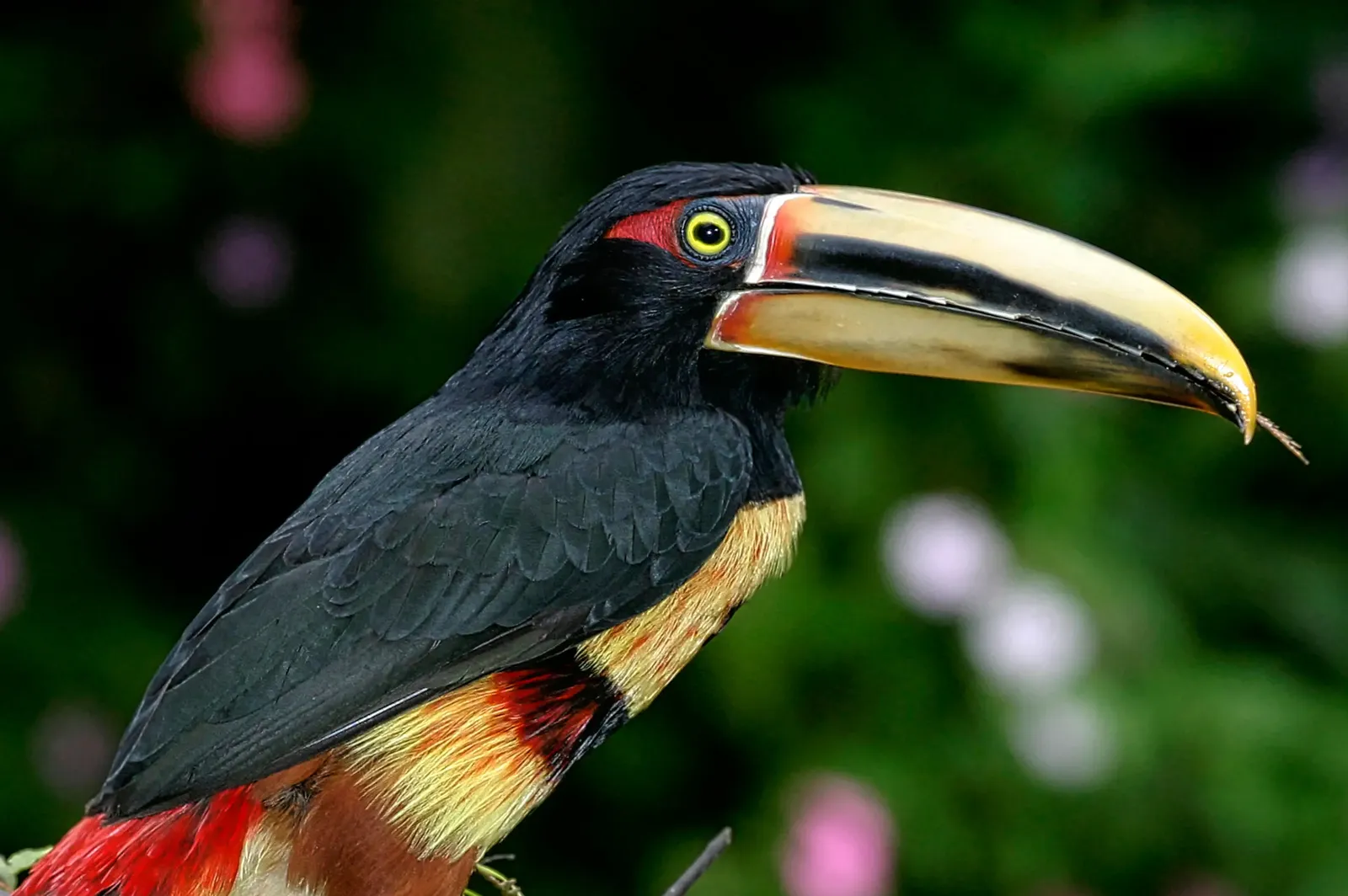
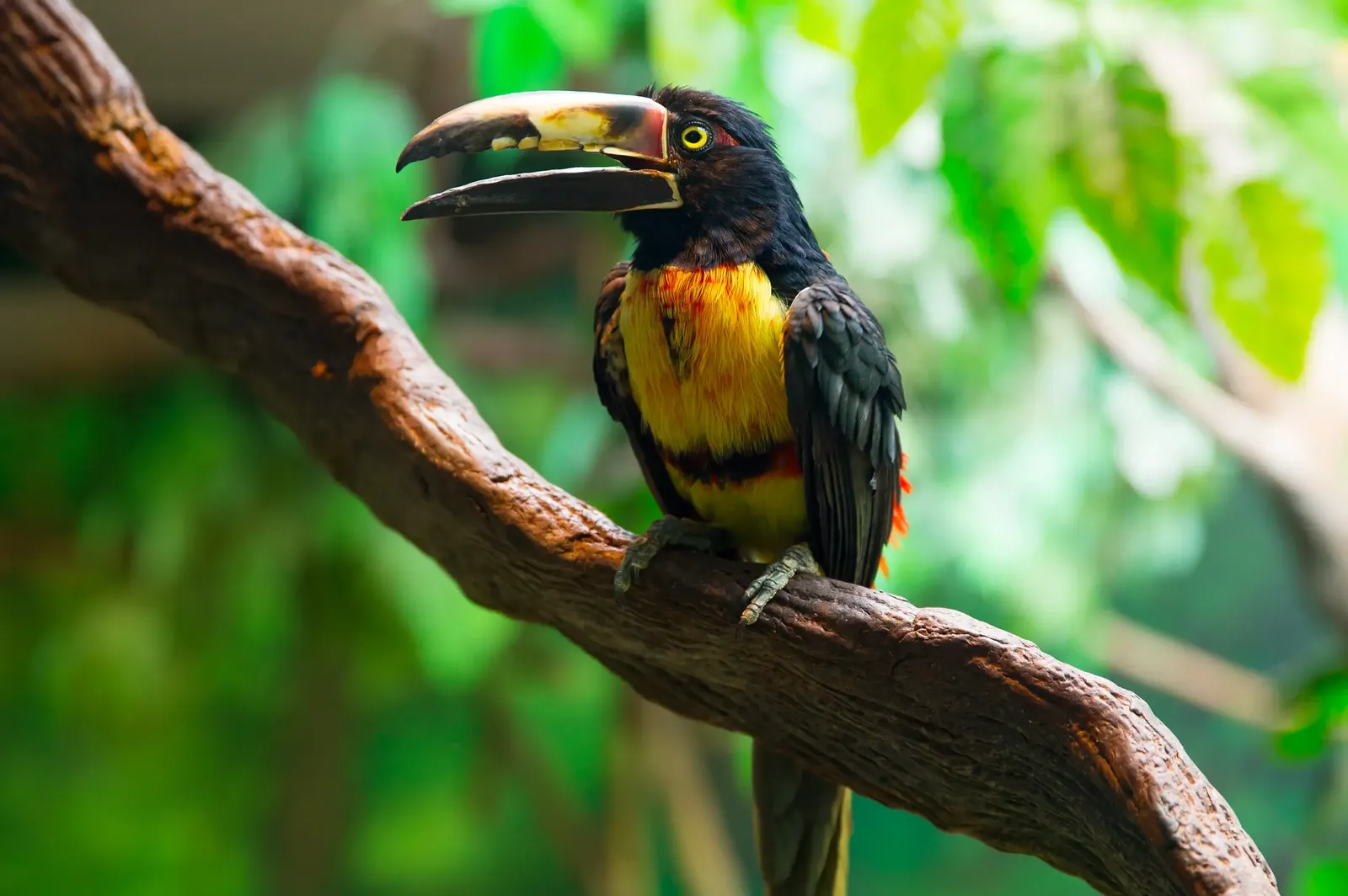
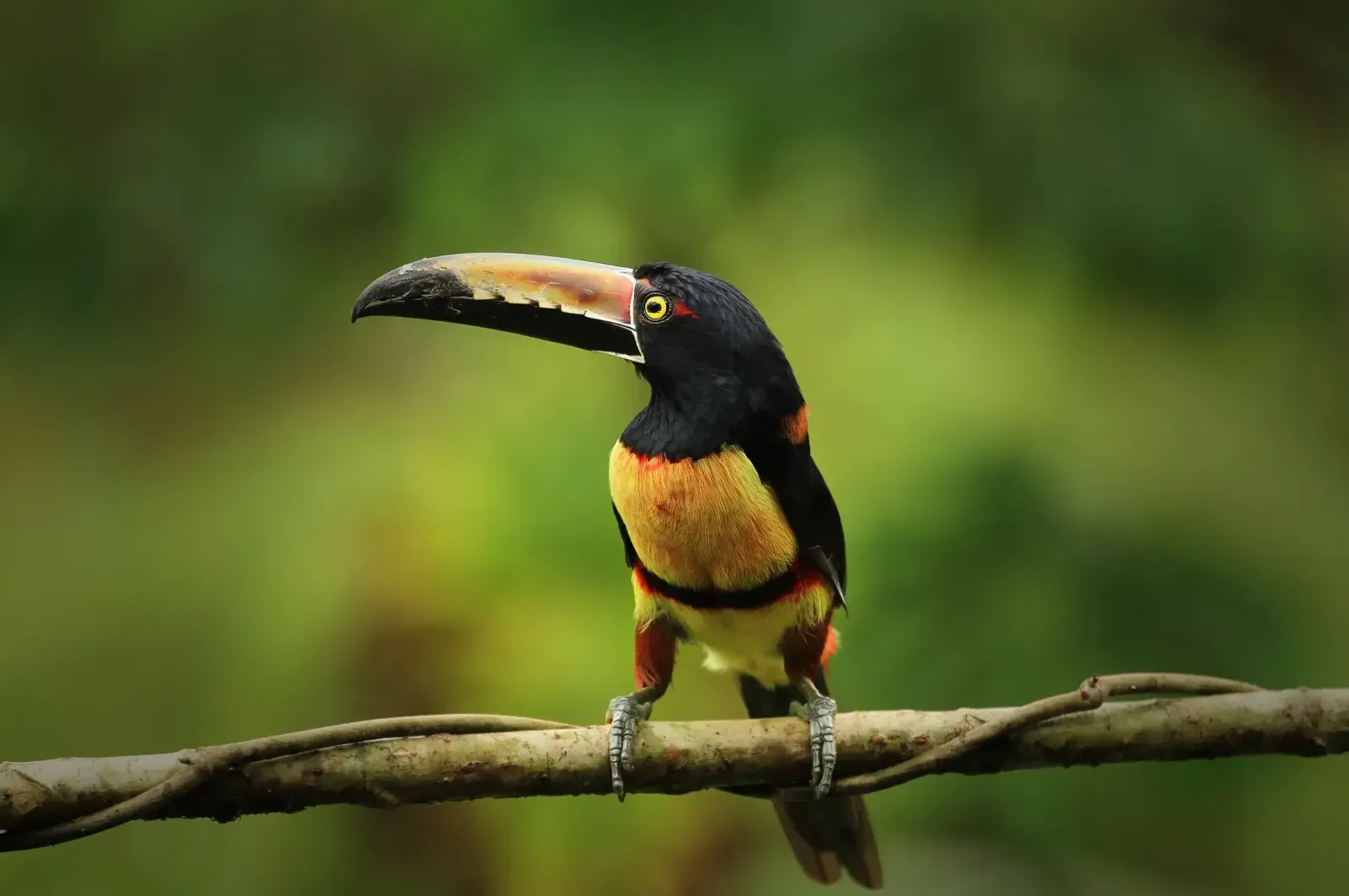
Pteroglossus aracari is a colourful toucan found in the tropical rainforests of Central and South America.
Its plumage is striking and colourful. It has bright colours, such as green, yellow and red.
Its long, curved beak is also a distinctive feature.
This toucan is a real visual spectacle in the rainforests where it lives.
The species is relatively secure in the wild and faces no immediate risk of extinction.
Reproduction
They nest in tree hollows and lay 2 to 4 eggs. Both parents participate in incubation and care of the chicks.
Behaviour
They are social birds and live in family groups. They like to move through the tree canopy in search of food. They are also known for their striking plumage and their ability to hop between branches.
Threats
Deforestation and capture for the pet trade are the main threats to this species. Habitat loss also affects their survival.
Feeding
Their diet consists mainly of fruit, especially figs, guavas and berries. They also consume insects, nectar and small vertebrates.
Distribution
Reproduction
The scarlet macaw breeds from the age of four years. In the breeding season, the female lays up to four eggs, which she incubates for 24-28 days. The chicks remain in the nest for about three to four months. Macaws are social birds that form large flocks.
Threats
The scarlet macaw faces several threats to its survival. The main threat is the loss of their natural habitat due to deforestation and fragmentation of tropical forests. This has reduced their living space, leaving them without suitable nesting and breeding sites. Another major threat is illegal animal trafficking. In addition, macaws in general are threatened by illegal wildlife trafficking and are one of the species banned for trade by the Convention on International Trade in Endangered Species of Wild Fauna and Flora (CITES).
Feeding
Its main food source is seeds, nuts and other dried fruits. In addition, it also consumes nectar, fruit and vegetation, such as flowers. This bird has the ability to ingest clay, especially on days when food is scarce and they need to ingest more toxic foods. Its strong, hooked beak allows it to open seeds and nuts, dig for small insects and collect various fruits.
Distribution
Reproduction
The Boa Constrictor is an ovoviviparous species, which means that the young develop inside eggs that remain inside the mother until they are ready to hatch. The gestation period varies between 5 and 8 months, and the female can give birth to between 10 and 60 offspring in a single litter. This snake reaches sexual maturity between 2 and 4 years of age, and both males and females are polygamous, and may have several mates in the same reproductive period.
Feeding
Boa constrictors are carnivorous and opportunistic in their diet. Its main prey are small mammals such as rodents, bats, birds and lizards. Larger boas may even prey on larger animals such as monkeys, agoutis and coatis. This snake captures its prey by stalking and wraps its own body around them, suffocating them as it kills by constriction. Finally, the animals are swallowed whole, always starting with the head.
Reproduction
The Yellow-fronted Amazon is a monogamous species that nests in tree cavities during the breeding season. The female lays between 2 and 4 eggs, which are incubated by both male and female for approximately 25 days. The chicks remain in the nest for a period that can vary greatly, with some leaving the nest after 25 days, and others for up to 70 days.
Distribution
Reproduction
Iguana reproduction is oviparous, which means that iguanas reproduce by laying eggs. The process varies depending on whether iguanas live in the wild or in captivity. In the wild, reproduction generally occurs between January and April, while in captivity, it extends from October to April. During mating, males and females perform head and tail movements, and if the female is receptive, she will facilitate the act by raising her tail. Mating lasts between 10 and 45 minutes. After two months, the female will lay around 80 eggs in a nest dug in soft ground. The eggs hatch 50 to 100 days later. During this process, the female stops feeding, but drinks plenty of water. In captivity, egg-laying can be planned by using a bed of sand covered with wet peat on the bottom of the terrarium.
Threats
The iguana is a fascinating species that faces a number of threats. Illegal hunting, habitat loss due to human development, illegal animal trade and the introduction of invasive species and diseases are some of the challenges affecting their survival. In addition, in their herbivorous diet, they feed mainly on leaves, flower buds and some fruits. It is essential to take measures to protect these creatures and ensure their conservation.
Threats
Deforestation, illegal hunting and conflicts with humans.
Distribution
Feeding
- Dry ration: Provides up to 10% of their maximum weight. Include high-energy macaw-specific feed, preferably from a good brand. In addition, you can offer nuts such as walnuts, almonds or hazelnuts (up to 25 grams).
- Fresh ration: This should be approximately 15% of the bird's weight. Include fruits and vegetables such as apples, pears, melons, peppers, oranges, carrots, broccoli, among others. You can also add cooked or sprouted legumes and some fresh unsalted cheese.
Distribution
Reproduction
The African Spurred Tortoise breeds during the rainy season, when food is plentiful. Females lay 15-30 eggs in a deep, sandy nest. These eggs hatch after about eight months, depending on temperature.
Feeding
Uromastyx are primarily herbivorous lizards that feed on dark leafy greens, vegetables such as carrots and courgettes, and fruits in small quantities. It is important to maintain a good calcium-phosphorus ratio in their diet for bone health.
Distribution
Threats
Habitat loss due to deforestation and illegal hunting are the main threats to this species.
Feeding
The African grey parrot feeds mainly on fruits, seeds, nuts and vegetables, although in the wild it also eats flowers, bark and sometimes small insects. In captivity it needs a varied and balanced diet, avoiding toxic foods such as avocado, chocolate and salt.
Reproduction
Breeding season is usually between April and May.
Mating occurs between individuals of the same group.
Gestation lasts approximately 135 days, and parturition occurs in September or October.
Threats
Habitat loss due to deforestation and capture for the pet trade are significant threats to lovebirds.
Feeding
They are omnivorous birds, which means that they feed on fruits, seeds and insects.
Their diet includes fresh fruit, vegetables, seeds and occasionally insects.
Behaviour
The Livingstone's turaco is diurnal and arboreal, spending most of the day feeding in the treetops. It is not a great flier and prefers to move by leaping or running along branches.
Feeding
It is a frugivorous bird, but also consumes shoots, leaves and even insects during the breeding season.
Feeding
They are omnivores and feed on fruits, flowers, nectar and small animals such as arthropods, worms, snails, frogs, lizards, small snakes and birds' eggs.
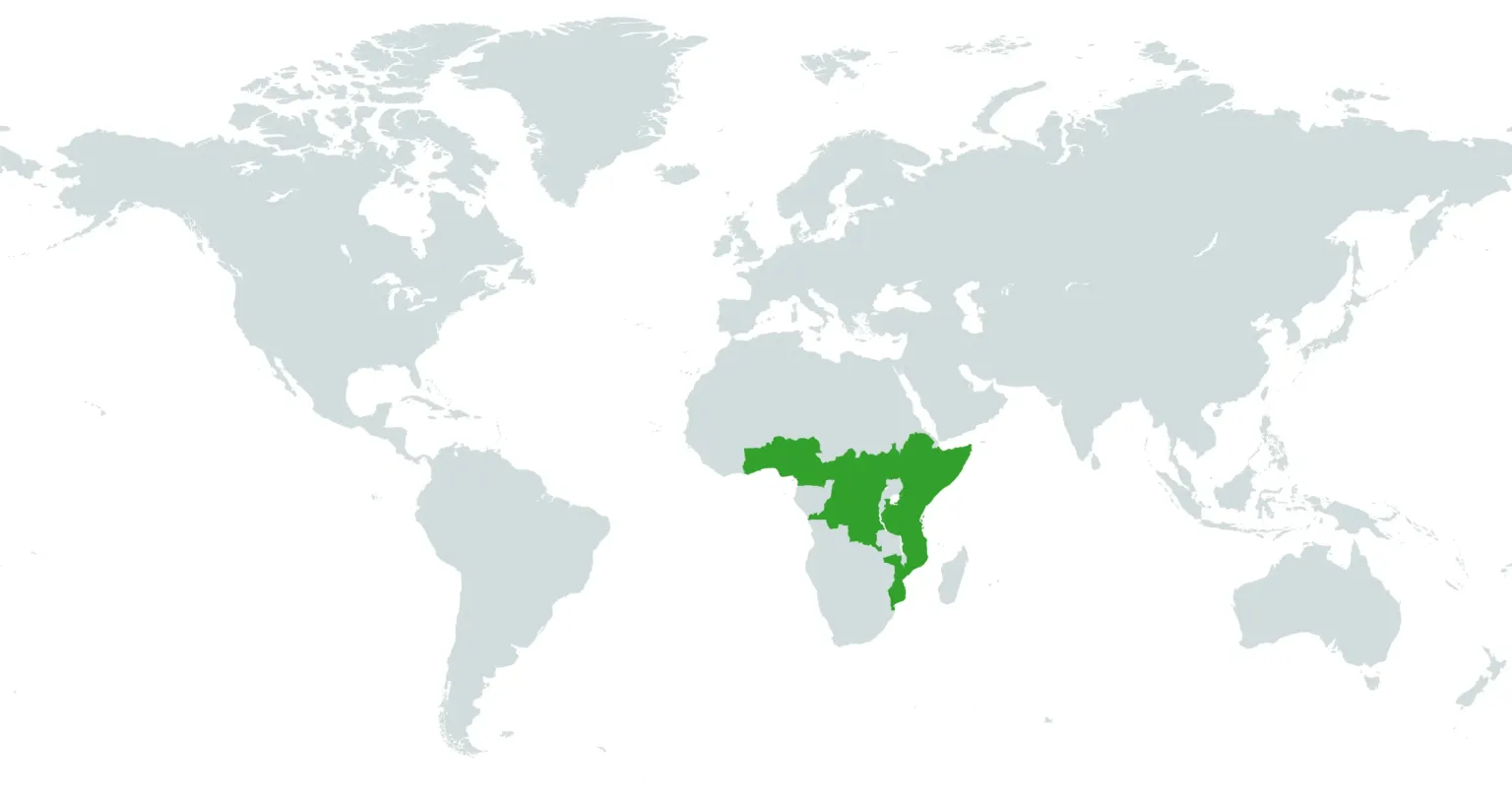
Distribution
Reproduction
The red-footed tortoise breeds all year round, although in the wild it usually breeds during the late rainy season between July and September.
1. The male attracts the female's attention by hitting her with his shell to show that he has a hard-on.
2. The male initiates head movements while the female remains still.
3. The male sniffs the female's tail.
4. Mating and mating takes place.
5. During courtship, the male emits a snapping sound.
Threats
The morroccoy faces significant threats due to habitat destruction and illegal capture for the pet trade. Conservation of this species is essential to protect biodiversity in the regions where they are found. Several conservation organisations and projects are working to ensure the survival of these turtles and their important contribution to ecosystem health.
Behaviour
The red-footed tortoise is a calm and sociable species.
- Activity: They are usually active in the morning and evening. In the hottest hours of the day, they prefer to hide among the grasses or in their hiding places. They do not like direct sunlight.
- Affinity for rain: They enjoy the rain very much.
Feeding
They are mainly frugivorous, meaning that they feed mainly on fruit.
They also consume leaves, flowers, nectar and insects.
Their diet varies according to the availability of food in their habitat.
Distribution
Behaviour
In the wild, they move in groups of up to 100 birds in search of water and food.
Reproduction
The white-handed gibbon reaches sexual maturity at 6 to 8 years of age. Breeding can occur at any time of the year. The gestation period is approximately 200 days. Females usually have a single calf every two to four years.
Feeding
The white-handed gibbon, Hylobates lar, has an omnivorous diet. A large percentage of its diet consists of fruit, especially figs (Ficus), but it also eats grapefruit, mangoes, leaves, flowers and buds. In addition to its plant-based diet, this gibbon also feeds on insects and small birds, which it catches with great agility while swinging in the trees. It also feeds on the eggs of these birds. After the morning cries, the group is on the move in search of food and in the afternoon there is a second meal, before the evening cry session.
Feeding
The diet of the red-eared slider is opportunistic and omnivorous. They consume both plant matter and invertebrates, and occasionally small vertebrates. Hatchlings are more carnivorous, but as they age, their diet becomes more plant-based.
Distribution
Behaviour
They are sociable and diurnal birds. They live in flocks and protect each other. If there is danger, they emit a distinctive sound to alert the others.
Distribution
Reproduction
We have no specific information on reproduction, but lizards generally lay eggs.
Feeding
They are omnivores, but mainly feed on insects. They also consume small mammals, birds and other reptiles, with a preference for rodents and lizards.
Reproduction
They nest in tree cavities or in nests abandoned by other birds.
The female lays 2 to 4 eggs and incubates them for about a month.
Threats
Icon for menu
Threats
Threats
Habitat loss due to deforestation is a significant threat to this species.
They can also be affected by pollution and illegal hunting.
Threats
Habitat loss: Deforestation and the expansion of agriculture and livestock reduce their living space.
Illegal hunting and trade: The scarlet macaw is a sought-after species in the exotic pet market. Illegal capture and trade severely affect their populations.
Reproduction
They are viviparous, which means that they give birth to live young.
Distribution
VU (Vulnerable)
It is at high risk of extinction in the medium term.
NT (Near Threatened)
It is not yet at risk, but could be soon if conditions worsen.
ALL
Not Used
EX (Extinct)
There are no longer any living individuals of the species.
EW (Extinct in the wild)
Only specimens survive in captivity or in scientific collections.
EN (Endangered)
It has a very high risk of disappearing in the wild if conservation measures are not taken.
CR (Critically Endangered)
It faces an extremely high risk of extinction in the near future.