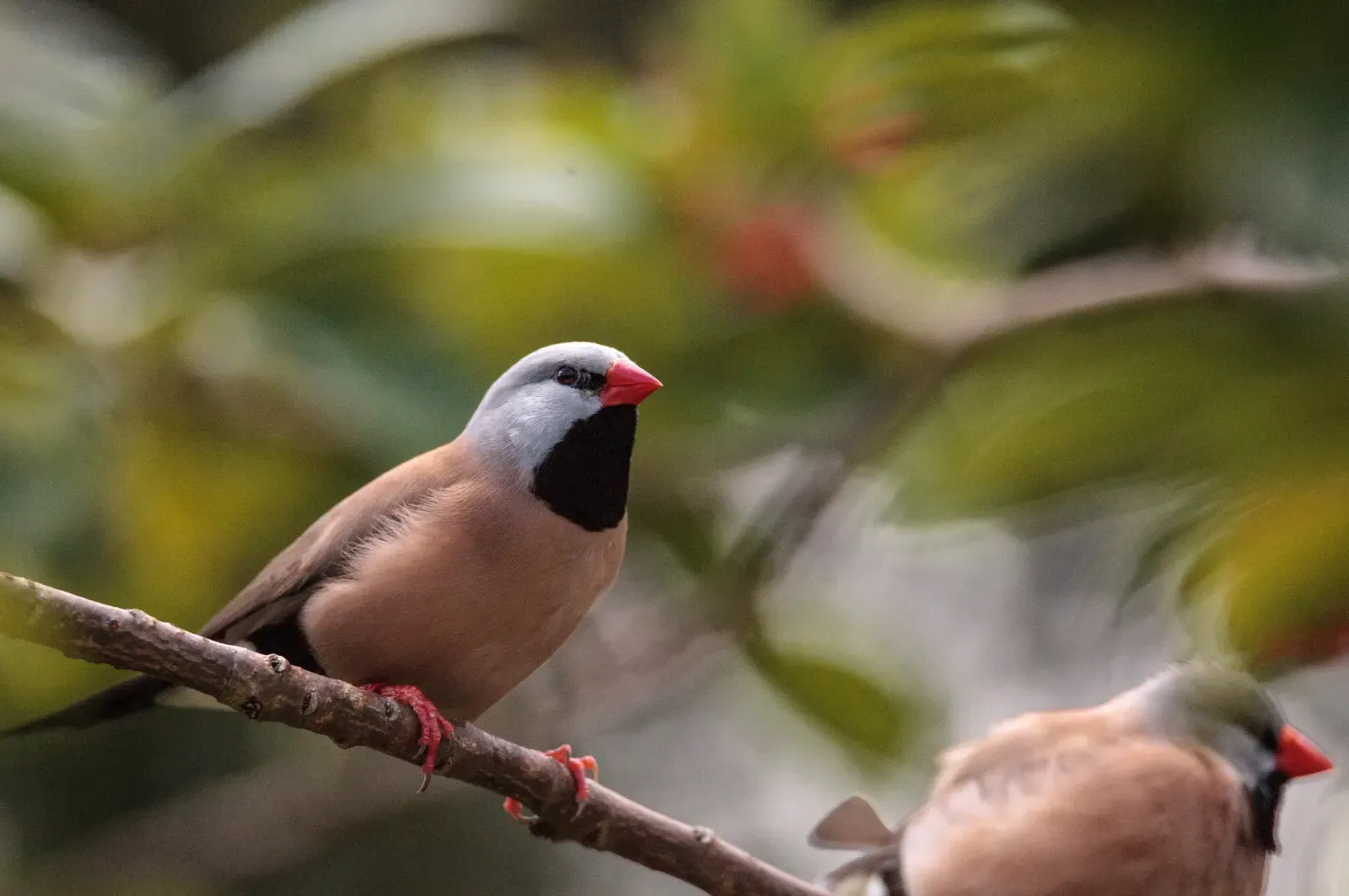
The plumage of the long-tailed diamond is remarkable for its simplicity and elegance.
Its upperparts are greyish with soft shades of brown, while the underparts are lighter, ending in white.
In addition, black flanks extend from the legs upwards, adding a distinctive touch to its appearance. Overall, its plumage is inconspicuous but charming.
The species is relatively secure in the wild and faces no immediate risk of extinction.
Reproduction
They lay 4 to 7 eggs, which the parents hatch for 14 days. Sex difference can be distinguished by subtle characteristics, such as the width of the bib and the colour of the beak.
Behaviour
They are docile birds and do not show much hostility towards people. They fly over river banks in search of food and often perch on the ground.
Threats
Its conservation status has been assessed as Low Concern (LC).
Feeding
The long-tailed diamondback feeds mainly on seeds and fruits. It also consumes insects and green shoots.
Distribution
VU (Vulnerable)
It is at high risk of extinction in the medium term.
NT (Near Threatened)
It is not yet at risk, but could be soon if conditions worsen.
ALL
Not Used
EX (Extinct)
There are no longer any living individuals of the species.
EW (Extinct in the wild)
Only specimens survive in captivity or in scientific collections.
EN (Endangered)
It has a very high risk of disappearing in the wild if conservation measures are not taken.
CR (Critically Endangered)
It faces an extremely high risk of extinction in the near future.